Showing posts with label Shakespeare. Show all posts

Monday, June 6, 2011

Discussion of The Great Night by Chris Adrian

The Great Night by Chris Adrian is Shakespeare’s A Midsummer Night’s Dream wearing the mask of tragedy.  Here’s a quick synopsis:  Three mortals coming from three different parts of San Francisco get lost in Buena Vista Park on Midsummer’s Eve.  They are all on their way to a party thrown by Jordan Sasscock.  The get lost because fairies live under the hill in the park, and Puck causes all hell to break loose.  Oberon, the fairy king, has left his wife, Titania, because she couldn’t stop grieving a dead human child they had both come to love.  Although Titania sent Oberon away, she is depressed and wants him to return home.  Desperate to get Oberon to return, she unleashes Puck from his magical bonds that keep him in control.  Puck is a murderous menace to faerie and mortals alike, and only Oberon can stop him.
            The three lost mortals are Henry, a pediatric oncologist with OCD issues resulting from his abduction as a child and his “mommy” issues.  He was dumped by his lover who couldn’t deal with his compulsive behaviors.  Then there is Will, an arborist/short story author, who falls in love with Carolina.  Will and Carolina both lost their brothers and hooked up in their mutual sorrow.  Carolina eventually dumps Will because of his sexually adventurous extra-relationship activities.  Will unrealistically hopes he’ll see Carolina at the party and get back in her good graces.  Finally, there is Molly, a floral shop girl, who grew up in an uber-religious family that rocked a Christian band.  They were like a Holy Rolling Partridge Family or the Jackson Five on Jesus.  During Molly’s childhood, she felt she didn’t fit in with her family and related better to the troubled foster children that cycled in and out of her home.  She tried becoming a Unitarian minister, but couldn’t relate to grieving parishioners.  That all changed when she found her boyfriend’s corpse hanging from a tree.   

Wednesday, April 13, 2011

Weird Sisters Bookmark

The Weird Sisters? (bookmark front)
The Book Phantom is wrapping up her “Fun with Shakespeare” reading experience.  Now it’s time to “close the book” on this reading module by sneaking a bookmark into my library book returns (did you know Shakespeare coined the term "to sneak"?).  It all started with Eleanor Brown’s new release The Weird Sisters (the title is a reference to the three witches in Shakespeare’s Macbeth).  The front of my bookmark is a vintage photograph of three wizened old gals.  It came from an old family album, but no one knows for sure who they are.  I call them the Weird Sisters because they look like they could stir up some “toil and trouble”. 

On the back of these Weird Sisters, I put a copy of the first scene from Macbeth, where the three witches meet and say the famous line: “Fair is foul, and foul is fair,” before taking off.

Act I Scene I from Macbeth (bookmark back)
In case anyone is interested in the titles from “Fun with Shakespeare”, I've included some "speed reviews":

Monday, April 11, 2011

Shakespeare and Renaissance Festivities

At Coventry, upon Saint Lambert's Day;
There shall your swords and lances arbitrate
The swelling difference of your settled hate.
       --William Shakespeare from Richard II (1.1.204-206)

Knights clashing in Knightdale, NC

The Book Phantom took a Shakespearean field trip this weekend to the NC Renaissance Faire in Knightdale (how appropriate is that location?).  The best feature of the fair is always the jousting.  In Shakespeare's time, jousting had become less about martial training and more about pomp at court.  On Queen Elizabeth I's Accession Day, tournaments were held for courtiers to honor the queen and to entertain the masses (even the public was admitted for a small charge).  The queen had her own champion at these events.  For 30 years, Sir Henry Lee fought for Her Majesty's honor.  In later years, her champions were Sir George Clifford (who wore her token glove pinned to his hat flap) and Robert Dudley.

Knights lancing the rings
Participants in the tilts would arrive in disguises and present the queen with an impresa, a pasteboard insignia that represented their tournament personae.  These knights would read a poem or speak prose which explained the impresa and the "theme" of their costumes.  Some nobles went to great pains and expense to hire artists and playwrights to devise these themes.  For the Accession Day of King James I on March 24, 1613, Francis Manners, Sixth Earl of Rutland, hired William Shakespeare to design his impresa for 44 shillings.  Shakespeare's friend Richard Burbage constructed and painted it for the same pay.  This wasn't the first impresa Shakespeare was known to design.  For his play Pericles, he designed the impresa his protagonist used in the joust scene.  (see Peter Ackroyd's Shakespeare: The Biography and Samuel Schoenbaum's William Shakespeare: a Compact Documentary Life)

As the Renaissance progressed, jousting declined in importance, especially in England.  The reasons are likely twofold:  1) the invention of the musket and use of gunpowder became more widespread, changing the skills a knight required in battle, and 2) the theater, with its costumes and pageantry, became the more popular form of entertainment for the people. 

Saturday, April 9, 2011

If Shakespeare Used Modern Slang...

I was just wondering, what if Shakespeare were alive and writing today?  He was only about twenty-four when he wrote his first play.  Do you think he’d use the modern lingo of teens and young adults?  Check out the meanings of these obsolete words from Shakespeare’s time and their modern slang counterparts.  I substituted slang into lines from his plays to try it on for size. 

Archaic:  ‘Sblood = by His (God’s) blood; this was preferred to taking God’s name in vain
Modern:  OMG (again, a way around blasphemy)
Example:  FALSTAFF: ‘Sblood, my lord, they are false! (from Henry IV)

               New FALSTAFF:  OMG, man, they are full of sh*t!

Archaic:  Fie! = an expression of dismay or disgust
Modern:  WTF!
Example:  NERISSA: Why, shall we turn to men?
                PORTIA: Fie, what a question’s that,
                                 If thou wert near a lewd interpreter?
                                  (from Merchant of Venice)

                 New NERISSA: So, we should cross-dress?
                 New PORTIA:  WTF?  What if some perv earjacked you?

Archaic:  Art = skill or talent in a particular field
Modern:  mad skills
Example: MIRANDA: If by your art, dearest Father, you have
               Put the waters in this roar, allay them. (from The Tempest)          

              New MIRANDA: Pops, if you caused this storm with your mad skills,  
              knock it off!

Monday, April 4, 2011

Review of The Weird Sisters by Eleanor Brown

The Weird Sisters by Eleanor Brown is one of Spring’s hot new releases.  When I picked up the book, I had a couple of fears.  First, I thought it would be just another dull, depressing family drama.  I have enough family baggage in my own life.  Why would I want read about this family when I barely want to be part of my own? 
My other reservation about this book is that I suspected it was Chick Lit being marketed as literary fiction.  Why should I fear Brown’s novel is over-hyped chick lit?  Because putting Shakespeare in stock characters' mouths won't make it a “serious literary work".  First, we have Cordy, the youngest sister, a wandering free-spirit who sleeps around and can’t settle down.  We have Bianca (aka Bean), the middle sister, a shopaholic who steals to support her clothes addiction, drinks fancy cocktails in NYC clubs, and who also sleeps around.  Finally, we have Rosalind, the eldest sister, who is an approaching-forty, dowdy-feeling professional woman who can’t let go of her control issues.  Brown gives us three Shakespearean-monikered characters, each of whom represents an archetype in the Chick Lit world. I refer you to an article called Bad Chick Lit Novel Clichés.  Brown includes 4 of the five Chick Lit situations in her novel: the shoe addiction, the surprise pregnancy, the sister’s wedding, and the “OMG, I’m turning 30!” crisis.  But don’t be put off Brown's novel yet – read on.

Thursday, March 31, 2011

King Lear - A Cautionary Tale for the Aging?

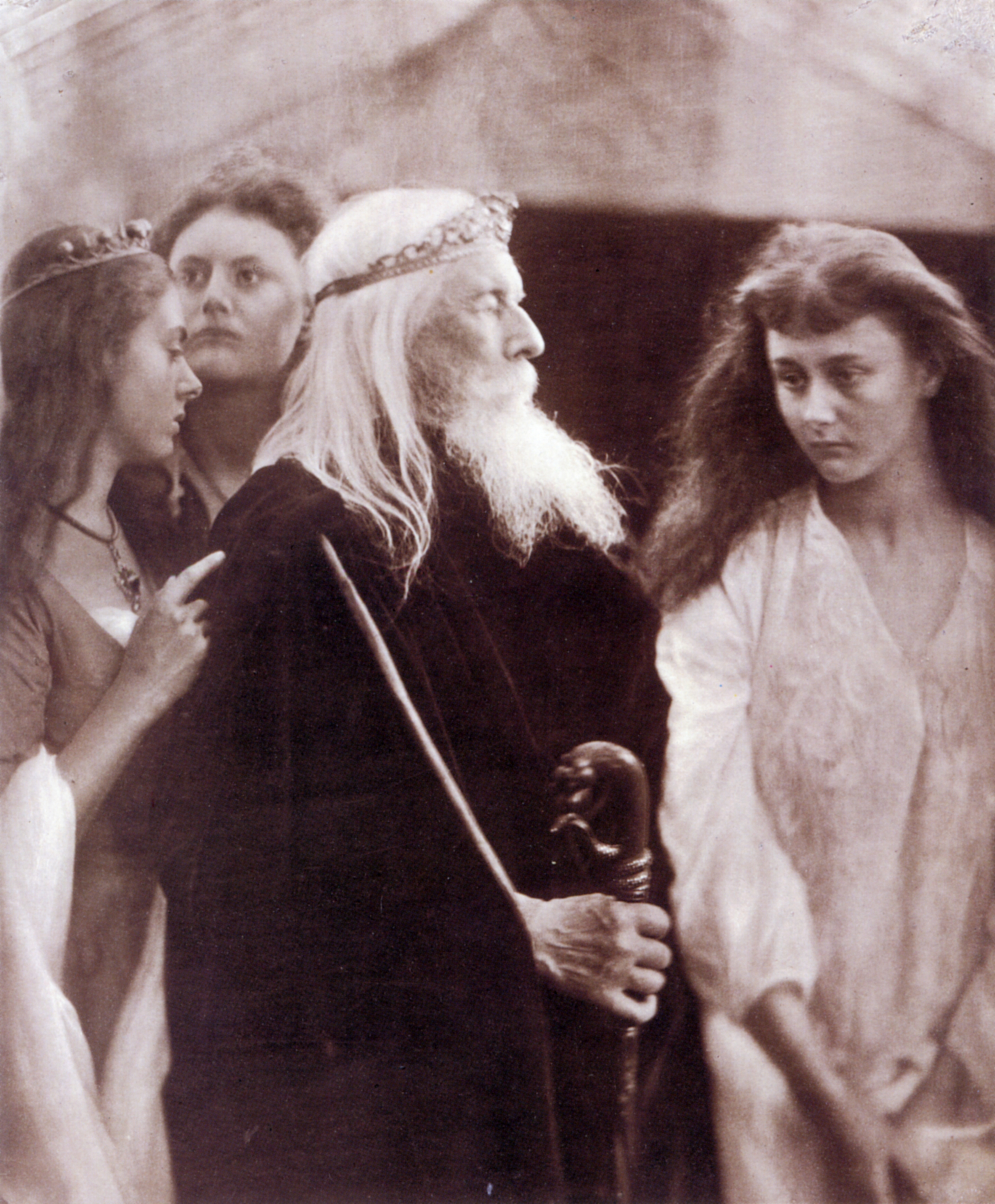
King Lear allotting his kingdom to his daughters by Julia Margaret Cameron, 1872
I admit it.  I haven’t read any Shakespeare since college, and that was (deep breath) nearly 20 years ago.  I’ve read a good deal of The Bard in my time, but, somehow, King Lear escaped my attention.  Book Phantom has remedied that.  When I began the play, I confess, the language was challenging.  I had to relearn how to read good Will.  I found it helpful to read aloud, because Shakespeare just sounds so darn good.  This exercise took me back to eleventh grade English in high school.  My teacher, Ms. Thomason, god bless her, had great taste in literature.  I give her full credit for instilling an appreciation of respectable reading.  Anyway, whenever we read plays aloud in class, Ms. Thomason almost always chose me to read the lead female parts.  That year I was Hedda Gabler, Medea, Antigone, and Lady Macbeth.  Either I was the only kid in class who could halfway read aloud, or Ms. T was trying to keep me from chatting up my neighbor across the aisle.  Nonetheless, I loved every minute of it, and this experience served me well when I read King Lear.
            Of all Shakespeare’s plays I could have chosen, why did I choose Lear?  Perhaps it’s because I am the youngest of three sisters, and I related to Cordelia.  Also, it seems so many books and movies reference Lear (A Thousand Acres comes to mind), and I needed to know more.  I was not disappointed – the word craft, the drama, the villains, the heroes, the tragedy – all timeless. 

Tuesday, March 29, 2011

April Reading List – Fun with Shakespeare

"My library was dukedom large enough."  - William Shakespeare, The Tempest 
I’m not really sure why I got a sudden yen to read Shakespeare.  Perhaps it’s because Eleanor Brown’s new novel, The Weird Sisters, is on my Spring to-read list.  Maybe it’s because I haven’t read any Shakespeare since college.  Whatever the reason, this month I’m getting my Bard on with selections that include Lear, Greer, and a few things weird.

New Release:  The Weird Sisters, by Eleanor Brown.  Three sisters return to their childhood home to be with their mother who’s dying of cancer, and their academic father who speaks in Shakespearean verse.  The names of the daughters?  Rosalind, Bianca, and Cordelia, of course.
Classic:  King Lear by well, you know who.  Three sisters compete for the affections of their aging father, the king.  Lear bequeaths his kingdom to his two eldest and silver-tongued daughters, whom he perceives love him most.  The third daughter, who loves him but refuses to flatter him, is cast out with no dowry.  Lear’s poor choice is the undoing of the whole family, as well as the state of Britain. 
Nonfiction:   Shakespeare’s Wife by Germaine Greer.  A controversial history that defends Shakespeare’s estranged wife, Ann Hathaway.  The link is to a YouTube lecture by Greer, who is quite funny in her scholarly way.
Juvenile:  Stage Fright on a Summer’s Night by Mary Pope Osborne.  My son is all about the Magic Tree House books right now.  What better way to introduce him to Shakespeare?
Inspiration:  Shakespeare’s Wordcraft by Scott Kaiser.  An outline of conventions and language devices in Shakespeare’s verse.